Bulgarians bring rich heritage to Bellevue | Choir, children’s school, theater group help many keep in touch with roots
Published 3:00 am Tuesday, September 4, 2012
By ROSE MARIE GAI
In May, Bulgarian President Rosen Plevneliev visited Seattle as part of a seven-day trip to the U.S. His reason? To focus on international trade; he was interested in the region’s success as a technology hub.
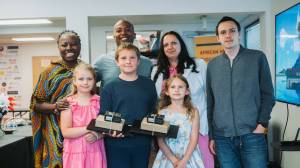
But there was more on Plevneliev’s agenda: meeting the people who have brought Bulgarian culture and heritage to this area: the Bulgarian Cultural and Heritage Center of Seattle, the Bulgarian Children’s School and the Bulgarian Theater Group. While the three groups operate separately, they all reflect the growing number of Bulgarians in the region.
Bellevue itself is home to nearly 5,000 Bulgarians. The count is unofficial, but represents a mailing list of the Bulgarian Cultural and Heritage Center of Seattle (BCHCS), according to Mary Sherhart, secretary of the organization.
According to its website, the center was established over a year ago to promote events and to preserve the heritage “related to traditional and contemporary Bulgarian culture.”
“When I got involved in this [Balkan music] in the ‘70s, there were only three Bulgarian families in the area,” said Sherhart, who also directs Bulgarian Voices in Seattle. “In the past 10 years the number of Bulgarians here has really grown.”
An explanation for the increase, particularly in Bellevue, is offered by Evgeniya Angelova, a vice president of the group’s heritage center.
“Bulgaria, for a small country, has produced a large group of information-technology specialists. There is a big group of Bulgarians [employed] with Microsoft,” she said.
Teodora Minkova, also a vice president of BCHCS, said one goal they have recently realized is to bring a Fulbright scholar from Bulgaria to teach at the University of Washington for the 2013-2014 academic year. They worked with the UW Department of Slavic Languages and Literature and the Fulbright association to make this happen.
Recently, the rich folklore of Bulgarian culture was featured prominently at the Seattle Folk Life Festival.
Bulgarian Voices in Seattle, a women’s choir, performed at the festival. It was founded just last October. Director Sherhart is not Bulgarian, but she is an ethnomusicologist, who studied and performed in Bulgaria and was involved in musical projects featuring other Eastern European countries as well.
“The one thing I felt I could contribute was to start a choir and help the Bulgarian women to discover their roots,” Sherhart said.
The choir is composed of 22 women ranging in age from 22 to 75. They practice every Wednesday in Bellevue.
Radost Folk Ensemble also performed at Folk Life. Radost means “joy” in the Slavic languages. The adult ensemble was established in 1976 to perform dance, music and songs of Eastern Europe in the Pacific Northwest. Radost recently established a children’s dance group and the age of the performers range from 2 to 11.
Dunava was also featured at Folk Life. This a cappella group of women, founded in 2005, sing songs from Eastern Europe and the Balkans. Dunava means “Danube” in Bulgarian.
“The Bulgarians coming into the community add a new thread to the rich tapestry of cultures in Bellevue,” Sherhart said.
She quoted Elka Rouskov, president of the BCHCS, who said that all she wants is “when someone asks me and I say that I am from Bulgaria – (that) they know where it is.”
For more information on the Bulgarian Cultural and Heritage Center, visit www.seattle-bg.org. To learn more about Radost visit www.radost.org. Dunava’s website is www.dunava.org.
Rose Marie Gai is a student in the University of Washington Department of Communication News Laboratory.